What the April 2026 Tax Changes Mean For You
The new tax year starts on 6 April 2026, and like every year, it brings some changes. This guide breaks down what you need to know, what the changes mean for you, and how we are supporting you as a Quartz client.
Got any questions?
Give our friendly, expert team a call on 020 3137 4408 or email us at hello@quartzpayroll.co.uk
1. Tax Rates and Thresholds
There are no changes to the tax and National Insurance (NI) thresholds in 2026. The Tax and NI threshold freeze is to be extended by three years until 2030/31.
The amount of Income Tax you deduct from your employees depends on their tax code and how much of their taxable income is above their Personal allowance.
The standard employee personal allowance for 2026 to 2027 tax year is £12,570. Your employee will only pay income tax on any earnings which are above the £12,570 threshold.
2. National Insurance Thresholds
Employer National Insurance
The rate of employer National Insurance Contributions (NICs) remains at 15%.
The threshold at which employers are liable to pay National Insurance (the Secondary Threshold) is £5,000 per year.
The Secondary Threshold is the point at which employers become liable to pay National Insurance Contributions (NICs) on employees’ earnings.
Employee National Insurance
There is no change to your employee’s national insurance rate from April 2026, this remains at 8%.
The class you pay depends on your employment status and how much you earn. If you are working age and earn less than the National Insurance Primary Threshold or Lower Profits Limit you will pay nothing.
3. National Minimum Wage
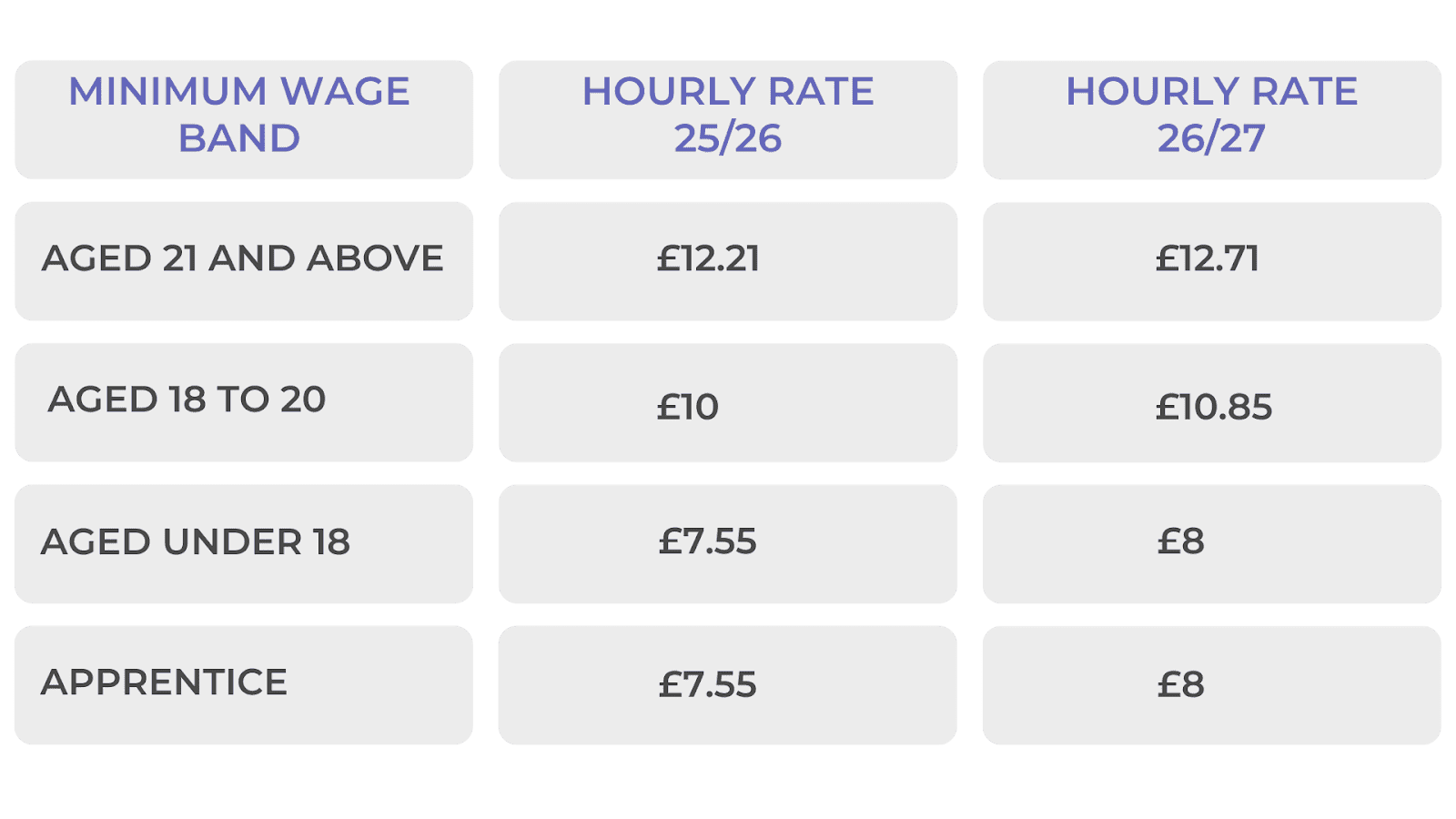
The National Minimum Wage and National Living Wage have increased for tax year 2026-27.
As an Employer you have a legal obligation to be compliant. With this in mind, please refer to the table below. If, based on the table below, you find that you need to adjust your employee’s salary, please advise us as soon as possible.
3.1. Salary Sacrifice and the National Minimum Wage
Any employees with whom you have a salary sacrifice arrangement need to be paid significantly *above* the National Minimum Wage.
This is because an employee’s *remaining* wage, after salary sacrifice, must still meet the National Minimum Wage. Please see the official government guidance: gov.uk/guidance/salary-sacrifice-and-the-effects-on-paye
What do you need to do as an employer?
- Check what the new National Minimum Wage rates are for the new tax year.
- Check that the employee’s remaining wage, after salary sacrifice, will still meet the new, higher National Minimum Wage.
- Alert us as soon as possible if you need to increase your employee’s wage ahead of the new tax year, to avoid them falling below the National Minimum Wage after salary sacrifice.
4. Statutory Sick Pay
Effective from April 2026:
- The weekly rate of statutory Sick Pay (SSP) is £123.25 or 80% of the employee’s average weekly earnings, whichever is lower.
- Statutory sick pay (SSP) will be paid from the first day of illness, instead of the fourth day.
- The lower earnings limit for SSP will be removed. As it stands, employees must earn a minimum amount to be eligible for statutory sick pay, this will be removed, meaning that all employees are entitled to SSP.
Example:
- In the current tax year: to qualify for Statutory Sick Pay (SSP), an employee must earn at least £125 gross per week. If an employee earns £100 gross per week, they are not entitled to SSP.
- From April 2026: the Lower Earnings Limit will be removed. This means all employees, even those earning under £125 gross per week, will be entitled to Statutory Sick Pay (SSP).

5. Statutory Payment Rates and Leave
Statutory Payment Rates
The Statutory Payment Rates for Maternity Pay, Adoption Pay, Paternity Pay, Shared Parental Pay, and Parental Bereavement Pay have increased to £194.32.
The first six weeks of Statutory Maternity Pay (SMP) and Statutory Adoption Pay (SAP) remain the same, at 90% of the employee’s average weekly earnings (AWE). The statutory weekly rate for the remaining 33 weeks will increase from April 2026 and will be £194.32 or 90% of the employee’s average weekly earnings, whichever is lower.
Statutory Paternity Pay (SPP), Statutory Shared Parental Pay (SPP) and Statutory Parental Bereavement Pay (SPBP) will all share the same weekly rate of £194.32 or 90% of the employee’s average weekly earnings, whichever is lower.
Paternity leave and unpaid parental leave
Paternity leave will become a ‘day one right’, allowing someone to give notice of leave from the first day of employment (currently, someone must have worked for their employer for 26 weeks to be eligible).
Ordinary parental leave will also become a day one right (currently, someone must have worked for their employer for 1 year to be eligible).
The restriction on taking paternity leave after shared parental leave will be removed.
6. Employment Allowance
Employment Allowance allows eligible employers to reduce their annual National Insurance liability up to the annual allowance amount which is £10,500 per tax year.
This means you will pay less employers class 1 national insurance each time payroll is run until the £10,500 has been used or the tax year ends (whichever is sooner).
If you have previously claimed Employment Allowance we will automatically continue to apply this.
If you are no longer entitled to claim due to business changes, please advise as soon as possible to reduce the potential of incorrectly claiming and payments needing to be repaid.
If you have not previously claimed, please complete this form and return in order for us to claim. We can retrospectively claim back 4 tax years.
For more information and to find out if you are eligible for employment allowance, click here.
7. Benefits in Kind
We can complete a submission to HMRC for any taxable benefits you are providing your employees with for £15.00 + VAT per submission.
All you need to do is let us know what the benefits are, and we will submit the P11D on your behalf. Some examples of benefits are a car for personal use, insurance, and gym membership etc.
As P11D’s must be submitted to HMRC by 5th July, we request that you declare to us the necessary information by 30th April, so we can prepare your P11D in good time. Late submissions may result in HMRC fines.
Click here for more information about Benefits in Kind.
8. Employment Law Changes
From April 2026:
- The Fair Work Agency will be established. This will bring together existing enforcement bodies and take on enforcement of employee rights such as payment of SSP, holiday pay and National Minimum/Living Wage. It will be a single place for employees to seek help for employment issues.
From October 2026:
- There will be a legal requirement for employers to prevent harassment of their employees by third parties.
- Employers must take all reasonable steps to prevent Sexual Harassment of their employees.
- The time limit for making an Employment Tribunal claim will be extended from three months to six months.
From 2027:
- From the 1st of January 2027, the qualifying period for Unfair Dismissal Employment Tribunal claims will be reduced from two years to six months. This means that from six months of employment, a ‘legally fair’ process must be followed before an employee is dismissed. The compensation cap for Unfair Dismissal will be removed resulting in uncapped financial compensation awards if an employment tribunal claim is successful.
- Enhanced Protection for Pregnant Employees and New Mothers, up to 18 months after birth. This is under review and further updates will be shared. Employers must approve Flexible Working Requests, unless they are not reasonably feasible. Employers will need to explain and evidence why the request is not reasonable.
- Individuals on Zero Hours Contracts (also known as ‘ad hoc’) will have the right to ask for guaranteed hours, as well as the right to be given reasonable notice and compensation for cancelled shifts.
- Employees will be entitled to unpaid Bereavement Leave of at least one week from day one of employment. This can be following the loss of a loved one or pregnancy loss under 24 weeks.
Please be aware that some of the future changes are still under consultation, so are subject to change. We will keep you updated with any changes, so that you remain legally compliant.
Updated March 2026